Learning how to shoot a bow is one of the most rewarding skills you can develop. Whether you're picking up a recurve for the first time or transitioning to compound, mastering archery shooting technique starts with understanding the fundamentals. This step-by-step guide covers everything from your first stance to your follow-through, giving you the bow shooting basics you need to hit the target consistently.
🏹 Equipment You Need Before You Shoot
Before you draw your first arrow, make sure you have the right gear. Using poorly fitted equipment is one of the fastest ways to develop bad habits and even injure yourself. Here is what every new archer needs:
Essential Gear
- • Bow — Recurve (20-25 lbs) or compound (40-50 lbs for adults)
- • Arrows — Properly spined for your draw length and bow weight
- • Arm guard — Protects your forearm from string slap
- • Finger tab or release aid — Protects fingers (recurve) or mechanical release (compound)
- • Target — Bag target, foam block, or straw bale
- • Quiver — Hip or bow-mounted to hold arrows safely
Pro Tip: Draw Weight Selection
The single biggest mistake new archers make is choosing a draw weight that is too heavy. If you cannot hold the bow at full draw for 10 seconds comfortably, the weight is too high. Start lighter than you think — a 20-pound recurve is perfect for learning how to shoot a bow with proper form. You can always increase weight later once your back muscles develop.
Not sure which arrows to buy? Our guide on choosing the right arrow spine walks you through matching arrows to your setup.
🦶 Step 1: Stance and Body Position
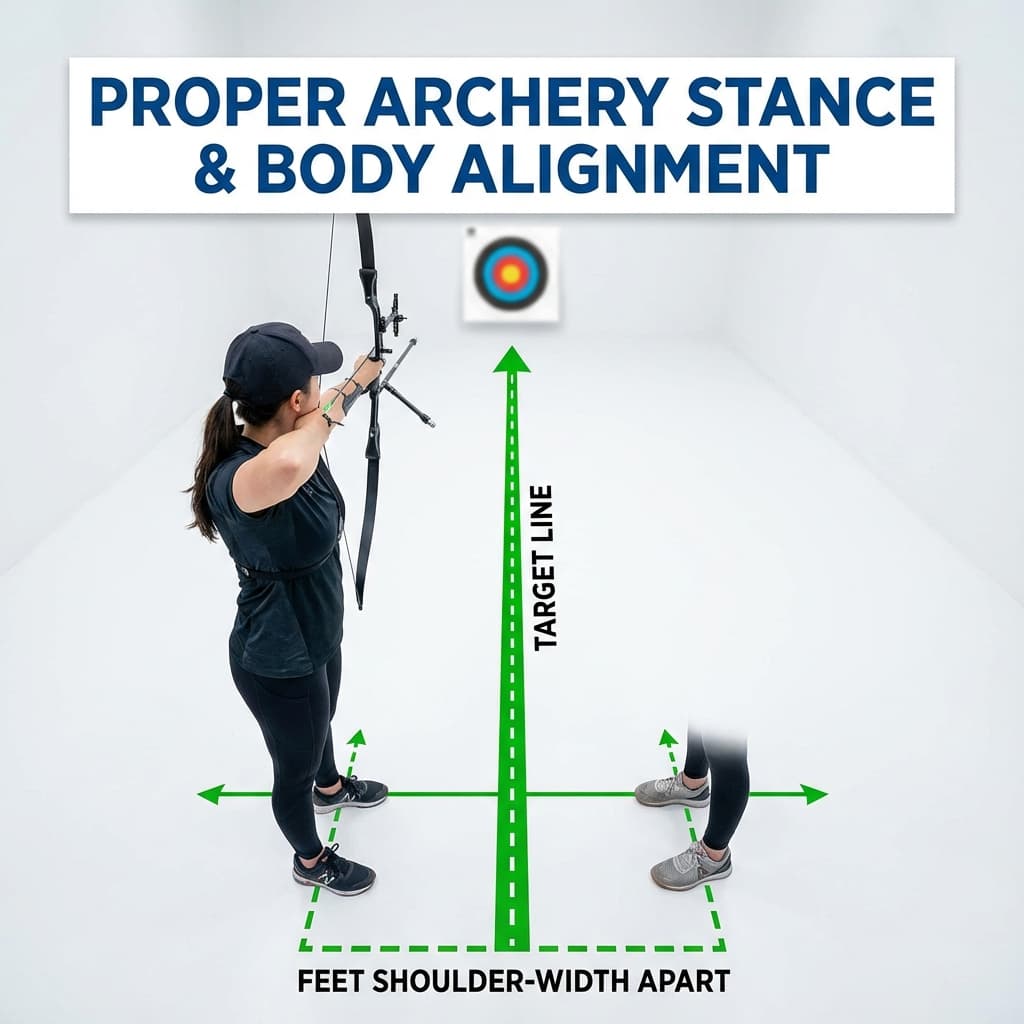
Your archery shooting technique begins from the ground up. A solid, repeatable stance is the foundation of every accurate shot. Without it, nothing else you do will be consistent.
How to Set Your Stance
- 1. Straddle the shooting line — Place one foot on each side, or both behind it depending on your range rules.
- 2. Feet shoulder-width apart — This gives you a stable base without overextending.
- 3. Weight evenly distributed — 50/50 on each foot, slight lean forward onto the balls of your feet.
- 4. Slight open stance — Turn your front foot about 15-30 degrees toward the target. This opens your chest and makes clearance easier.
- 5. Knees slightly soft — Do not lock your knees. A slight bend prevents fatigue and keeps you balanced.
- 6. Hips square to the shooting line — Resist the temptation to twist your body toward the target.
Your upper body should be upright and relaxed. Think about standing tall with your shoulders down and back. Tension in the shoulders is the enemy of good archery form. For a deeper dive into foot positioning, read our complete archery stance guide.
🔧 Step 2: Nocking the Arrow
Nocking is the process of placing your arrow on the bowstring and arrow rest. It sounds simple, but doing it correctly and consistently is a key part of bow shooting basics.
Nocking Procedure
- • Hold the bow in your bow hand (non-dominant hand for most archers) pointing toward the ground at a slight angle.
- • With your drawing hand, pick an arrow from the quiver by the shaft near the nock.
- • Place the arrow on the arrow rest with the index fletch (odd-colored vane) pointing away from the bow.
- • Snap the nock onto the string at the nocking point — you should feel and hear a slight click.
- • The arrow should rest naturally on the shelf or rest without you holding it in place.
⚠️ Safety Warning
Never nock an arrow until you are on the shooting line and it is safe to shoot. Always keep the arrow pointed downrange once nocked. Never draw a bow without an arrow (dry firing) — this can shatter the limbs and cause serious injury.
💪 Step 3: Drawing the Bow
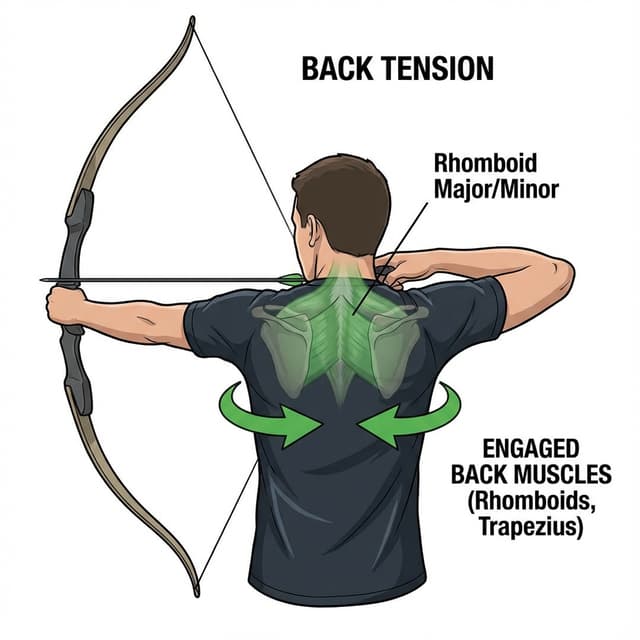
The draw is where many beginners develop problems. The most important concept to understand is that you draw with your back muscles, not your arms. Your arm is just the connection between your back and the string.
Proper Drawing Technique
- 1. Set your bow hand — The pressure point should be on the meaty pad of your thumb. Fingers relaxed and slightly curled. Never grip the bow tightly.
- 2. Hook the string — For recurve, use a three-finger hook (one above the nock, two below). For compound with a release, clip onto the D-loop.
- 3. Raise the bow — Extend your bow arm toward the target at shoulder height. Keep the shoulder down and locked.
- 4. Initiate the draw — Pull the string back by squeezing your shoulder blades together. Imagine pinching a pencil between them.
- 5. Draw in a straight line — The drawing hand should travel straight back along the side of your face, not in an arc.
- 6. Keep your bow shoulder down — If it creeps up toward your ear, you are using too much arm and not enough back.
Pro Tip: The Back Tension Test
Have someone place their hand flat on your back between your shoulder blades while you draw. They should feel your muscles engage and your shoulder blades move together. If they do not feel anything, you are arm-drawing, which leads to fatigue, inconsistency, and potential shoulder injuries over time.
📍 Step 4: Anchoring
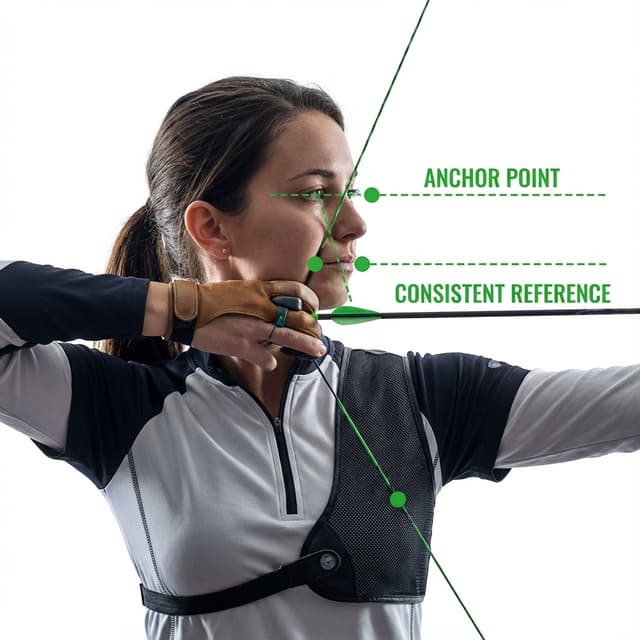
The anchor point is where your drawing hand comes to rest on your face at full draw. This is arguably the most critical element of consistent archery shooting technique, because even a millimeter of variation here translates to inches of error at the target.
Common Anchor Points
Recurve / Barebow
Index finger in the corner of your mouth, string touching the tip of your nose and chin. This gives you three reference points for maximum consistency.
Compound with Release
Knuckle of your index finger behind the jawbone, string touching the tip of your nose. The release hand nestles under the jaw for a solid bone-to-bone contact.
Olympic Recurve
Index finger under the chin, string on the nose and chin. The tab sits right along the jawline. This is the standard for competitive recurve archery.
For a complete breakdown of anchor points for every bow type, check out our dedicated archery anchor point guide.
🎯 Step 5: Aiming
How you aim depends on your equipment and style. There is no single "right" way — what matters is choosing a method and practicing it until it becomes second nature.
Using a Sight
Most beginners start with a pin sight. Align the appropriate pin with the target center. For compound bows, center the pin inside your peep sight. Focus on the target, not the pin — let the pin float naturally over the gold.
Gap Shooting (No Sight)
Use the tip of your arrow as a reference. The "gap" is the distance between where your arrow tip points and the target center. At your point-on distance, the tip sits right on the gold. Closer or farther, you adjust the gap accordingly.
Instinctive Aiming
Like throwing a ball — you look at the target and your brain calculates trajectory through practice and repetition. No conscious aiming reference is used. This takes thousands of arrows to develop but feels the most natural.
String Walking
A barebow technique where you move your finger position on the string to adjust for distance. The arrow tip always points at the target center, and vertical adjustment comes from the crawl (distance your fingers are below the nock).
We cover every aiming method in detail in our how to aim in archery guide.
🚀 Step 6: Release and Follow-Through
The release is the moment of truth. Everything you have done so far — stance, draw, anchor, aim — leads to this instant. A clean release lets all that preparation pay off. A bad release undoes everything.
Finger Release (Recurve)
- • Continue engaging your back muscles after reaching anchor — this is called expansion or back tension.
- • Let the string slip off your fingers naturally. Do not actively open your hand or pluck the string.
- • Your drawing hand should move straight back along your face and end up near your ear or behind your neck.
- • The bow arm stays extended toward the target. Do not drop it until the arrow hits.
Mechanical Release (Compound)
- • Continue pulling through the shot with back tension until the release fires.
- • For a trigger release, squeeze slowly — never punch or slap the trigger.
- • For a hinge release, rotate through the shot and let the release fire as a surprise.
- • Your hand should travel back along your neck after the release fires.
Pro Tip: The Follow-Through Check
After the shot, freeze. Where is your bow hand? Still extended toward the target — good. Where is your release hand? Behind your ear or neck — good. Are you still looking at the target through your sight or over your arrow? Good. If any of these are off, your release was not clean. Hold your follow-through for a full second after every shot.
⚠️ Common Beginner Mistakes When Learning How to Shoot a Bow
Almost every new archer makes these mistakes. Recognizing them early saves you months of frustration and bad habit correction.
❌ Death Gripping the Bow
A tight grip torques the bow on release, throwing arrows left or right. Use a relaxed hand with a wrist sling to catch the bow.
❌ Dropping the Bow Arm
Lowering your arm before the arrow reaches the target causes low hits. Keep aiming until you hear the arrow hit.
❌ Plucking the String
Pulling the string sideways on release instead of letting it slip naturally. This sends arrows wildly off course.
❌ Inconsistent Anchor
Anchoring in a slightly different spot each shot creates scattered groupings. Use multiple reference points to lock in your anchor.
❌ Overdrawing
Pulling past your anchor point collapses your form and changes your power stroke. Draw to anchor and stop.
❌ Rushing the Shot
Spending less than 3-5 seconds at full draw often means your alignment is not set. Develop patience at anchor before releasing.
For a full breakdown, see our article on the top 10 archery form mistakes beginners make.
📈 Practice Progression for New Archers
You know the steps — now here is how to practice them effectively. Resist the temptation to shoot at a target face right away. Building bow shooting basics through blank bale practice first will accelerate your progress dramatically.
Recommended Practice Phases
Phase 1: Blank Bale (Week 1-2)
Shoot at a plain target from 5 yards. Focus entirely on form — stance, draw, anchor, release. No aiming. 30-50 arrows per session.
Phase 2: Close Target (Week 3-4)
Add a target face at 10 yards. Begin aiming but keep primary focus on form. 40-60 arrows per session.
Phase 3: Distance Building (Week 5+)
Gradually move back to 15, then 20 yards. Start scoring to track improvement. 50-80 arrows per session.
Want a complete day-by-day plan? Our archery beginner's 30-day guide gives you exactly that.
📊 Tracking Your Shooting Progress
Once you start scoring, tracking your sessions is the fastest way to identify patterns and improve. Record your scores, distances, arrow count, and any notes about form changes. Over time, the data reveals which parts of your archery shooting technique need the most work.
Pro Tip: Film Your Form
Set up your phone to record yourself from the side. Compare your form to the steps in this guide. You will be surprised how different what you think you are doing is from what you are actually doing. ArcheryBuddy can analyze your form with AI and give you instant feedback on what to fix.
Master Your Bow Shooting Technique
Use ArcheryBuddy to get AI-powered form analysis, track your scores over time, and follow structured practice plans designed to improve your accuracy.
🎯 Quick Accuracy Checklist
- ✓Consistent stance — Same foot position every single shot
- ✓Relaxed grip — Pressure on the thumb pad only, fingers loose
- ✓Back tension draw — Shoulder blades engaged, bow shoulder down
- ✓Solid anchor — Multiple reference points, same position every time
- ✓Steady aim — Let the pin float, do not chase the gold
- ✓Clean release — Back tension fires the shot, not a conscious decision
- ✓Hold follow-through — Freeze after the shot for at least one second
✅ Key Takeaways
- ✓Start with properly fitted equipment — especially correct draw weight
- ✓Build from the ground up: stance, nock, draw, anchor, aim, release, follow-through
- ✓Use back muscles for the draw, not your arms
- ✓A consistent anchor point is the single most important factor for accuracy
- ✓Start with blank bale practice, then add targets gradually
- ✓Track your sessions and film your form to accelerate improvement
Learning how to shoot a bow is a journey that rewards patience and deliberate practice. Focus on one step at a time, build solid fundamentals, and the accuracy will follow. For more tips on dialing in your accuracy, check out our archery accuracy improvement guide.