The archery anchor point is the single most important factor in shot-to-shot consistency. It is the fixed reference position where your drawing hand meets your face at full draw, and even a tiny variation — a couple of millimeters — can send your arrow inches off target at distance. This guide explains where to anchor in archery for every bow type, how to develop rock-solid consistency, and drills to lock in your anchor point for competition-level repeatability.
📍 What Is an Archery Anchor Point?
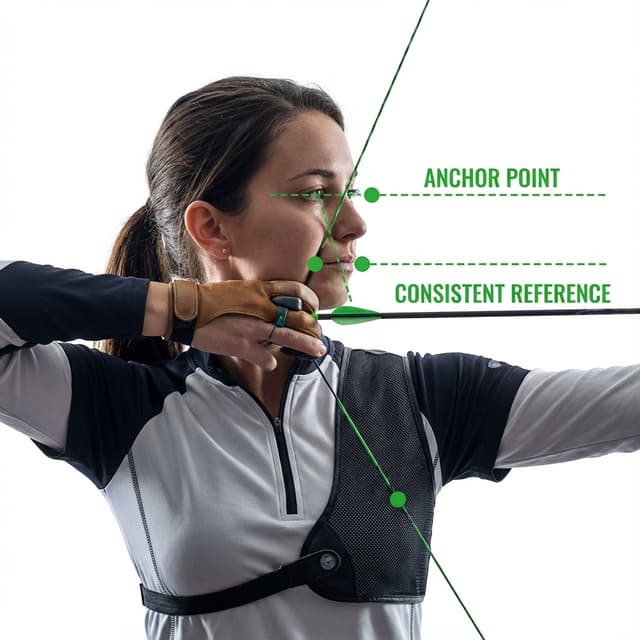
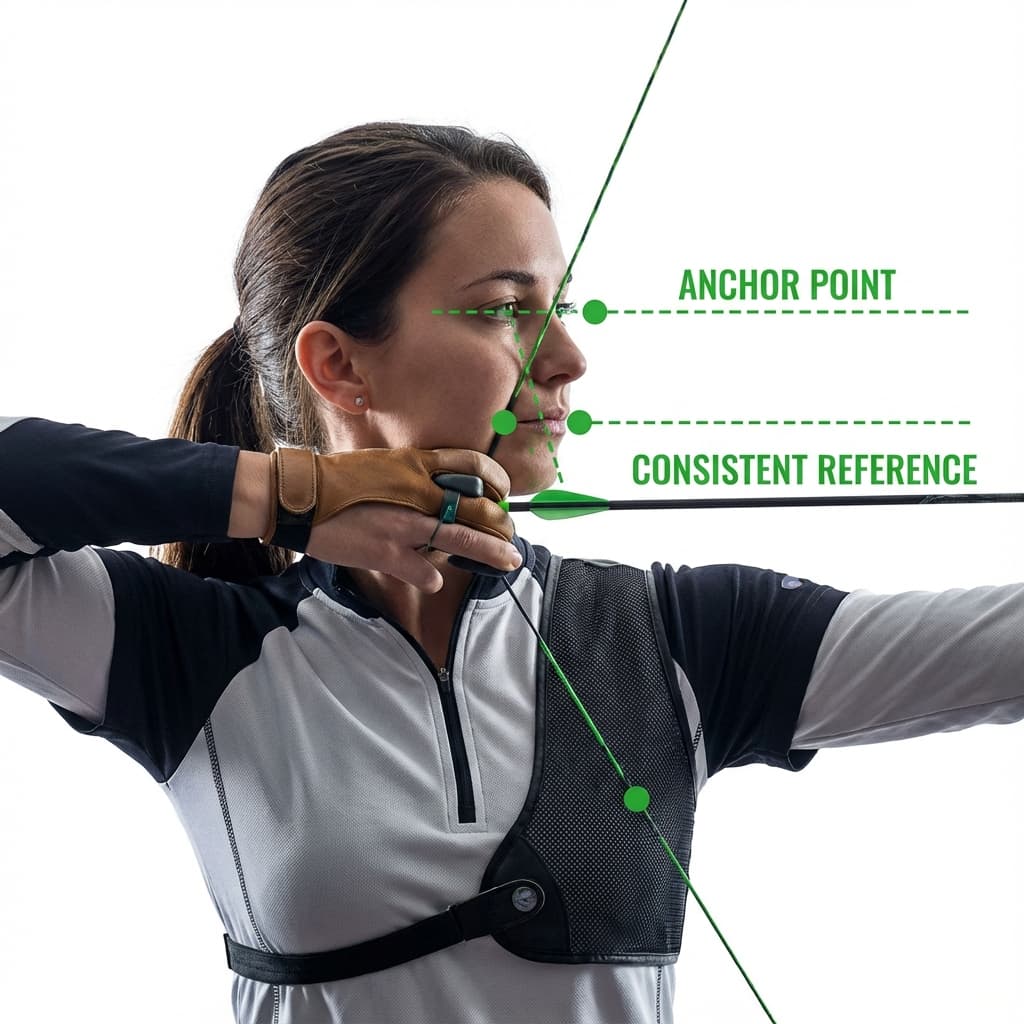
Your anchor point in archery is the specific spot on your face where your drawing hand consistently comes to rest at full draw. Think of it as the rear sight of a rifle — it determines the back end of your aiming line. If the front end (your sight pin or arrow tip) is consistent but the back end (your anchor) moves, your arrows will scatter.
What Makes a Good Anchor Point?
- • Bone-to-bone contact — Your hand or release should press against a bony landmark on your face, not soft tissue that compresses differently each time.
- • Multiple reference points — The best anchors use 2-3 contact points (hand on jaw, string on nose, string on chin) for triangulation.
- • Comfortable and sustainable — You must be able to hold this position for 5-8 seconds without strain or shaking.
- • Natural for your draw length — Forcing an anchor that does not match your draw length creates tension and inconsistency.
🎯 Why Anchor Point Consistency Matters
Let us put some numbers on this. At 70 meters (Olympic distance), a 1mm change in your anchor point vertically translates to roughly 10-15cm of vertical movement on the target face. That is the difference between a 10 and a 7. Horizontally, the effect is similar.
Up to 15cm of error at 70m — the width of the 8-ring
Up to 30cm of error — you are off the gold entirely
What elite archers achieve — tight X-ring groups
This is why Olympic archers obsess over their anchor. It is not about finding a "good enough" position — it is about finding a position you can replicate within a fraction of a millimeter, thousands of times.
🏹 Recurve Bow Anchor Points
Recurve archers use a finger draw (Mediterranean draw), which means the anchor involves placing your fingers against your face. There are two primary recurve anchor styles:
Olympic / Under-Chin Anchor
This is the standard for competitive recurve archery and provides the most reference points:
- • Index finger nestles under the jawbone — this is the primary bone-to-bone contact.
- • Bowstring touches the center of your chin — second reference point.
- • Bowstring touches the tip of your nose — third reference point.
- • The tab sits flat along the underside of your jaw.
- • Your thumb may tuck against your neck for an additional reference.
Corner-of-Mouth Anchor (Traditional / Barebow)
Popular with traditional and barebow archers, especially those using gap shooting or instinctive aiming:
- • Index finger presses into the corner of your mouth — primary reference.
- • Bowstring touches the tip of your nose — secondary reference.
- • Your thumb may rest along the back of your jawbone.
- • The middle finger may align with the bottom of your cheekbone.
⚙️ Compound Bow Anchor Points
Compound archers typically use a mechanical release aid, which changes the anchor mechanics significantly. The hand position is different from a finger release, and compound bows have the added benefit of a peep sight for visual alignment.
Standard Compound Anchor
- • Knuckle of the index finger (or the release body) presses against the back of the jawbone, just below and behind the ear.
- • Bowstring touches the tip of your nose — this confirms your head position is consistent.
- • Peep sight aligns with your eye and the sight housing — this is your visual anchor confirmation.
- • The D-loop should be at the same height on the string every time (check nocking point regularly).
Pro Tip: The Kisser Button
A kisser button is a small plastic disc attached to your bowstring that touches the corner of your mouth at full draw. It adds an additional tactile reference point to your anchor. While not all compound archers use one, it is especially helpful for beginners learning where to anchor in archery. Combined with string-on-nose and knuckle-on-jaw, you get three physical reference points plus one visual (peep alignment).
🔗 Building Multiple Anchor Reference Points
The key principle behind a reliable anchor point archery system is redundancy. One reference point is unreliable. Two is better. Three or more is what competitive archers use. Here is how to build a multi-point anchor system:
The Reference Point Checklist
Tactile References (Feel)
- • Hand/fingers on jaw or mouth — primary contact
- • String on nose tip — confirms head position
- • String on chin — confirms draw length
- • Thumb on neck — secondary hand position check
- • Kisser button on lips — additional string position reference
Visual References (See)
- • Peep sight alignment with scope housing (compound)
- • String alignment with riser or sight (recurve)
- • Consistent sight picture — same blur pattern around the pin
Pressure References (Force)
- • Consistent pressure of fingers on string (recurve)
- • Consistent pressure of release hand against jaw (compound)
- • Consistent draw weight feel at the wall (compound)
Integrating your anchor into a complete pre-shot routine makes it automatic. Read our guide on building the perfect pre-shot routine to see how anchor fits into the full shot sequence.
⚠️ Common Anchor Point Mistakes
❌ Floating Anchor
Not fully committing to contact with the face. The hand hovers near the jaw instead of pressing firmly against it. This creates inconsistent draw length from shot to shot.
❌ Creeping Forward
Slowly letting the string creep forward after anchoring, shortening your draw length. Often caused by insufficient back tension or too much draw weight.
❌ Head Tilting to Meet the String
Moving your head to the string instead of bringing the string to your face. This changes your eye position and ruins your sight picture. Always bring the string to a stationary head.
❌ Using Only One Reference Point
Relying on just one contact point means you cannot detect when you are slightly off. Always build a system with at least two, ideally three reference points.
❌ Changing Anchor Between Distances
Your anchor should be identical at every distance. Sight adjustments or gap changes handle the distance — never move your anchor to compensate (except in deliberate string walking).
❌ Rushing to Anchor
Slamming into anchor and immediately releasing. Take a beat to verify all reference points are in place before initiating the aiming and expansion phase.
🏋️ Drills for Anchor Point Consistency
Drill 1: Mirror Draw (No Bow)
Stand in front of a mirror and mime your draw sequence with an empty hand. Watch your hand travel to anchor and check that it arrives at the exact same spot every time. Do 20 repetitions. This builds the neural pathway without fatigue.
Drill 2: Eyes-Closed Anchor
At blank bale (close range, no target face), draw to anchor with your eyes closed. Focus entirely on the feel of your reference points. Can you tell if the string is on your nose? Is your finger in the right spot on your jaw? Shoot 10 arrows this way.
Drill 3: Hold and Verify
Draw to anchor and hold for 8-10 seconds before releasing. During the hold, mentally check each reference point: finger on jaw — check. String on nose — check. String on chin — check. Release only after confirming all points.
Drill 4: Video Overlay Comparison
Film yourself from the side for 6 arrows. Compare the frames at full draw — your hand should be in the exact same position in every frame. Any variation is visible and tells you what to fix.
Drill 5: Stretch Band Reps at Home
Use a resistance band to simulate your draw. Practice coming to anchor 30-50 times while watching TV or listening to a podcast. The goal is to make anchor placement so automatic that you do not have to think about it.
Pro Tip: Track Your Anchor Consistency
After each practice session, rate your anchor consistency on a 1-10 scale in your training log. Over time, you will see the correlation between anchor consistency scores and group sizes. ArcheryBuddy lets you log session notes alongside your scores so you can identify these patterns automatically.
Analyze Your Anchor with AI
Use ArcheryBuddy's AI form analysis to verify your anchor point consistency from video. The app detects your hand position at full draw and flags any variations between shots.
✅ Key Takeaways
- ✓Your archery anchor point is the rear reference for your aiming system — millimeters matter
- ✓Use bone-to-bone contact for your primary anchor reference
- ✓Build a system of 2-3 reference points (tactile + visual) for maximum consistency
- ✓Recurve: under-chin (Olympic) or corner-of-mouth (traditional) depending on your discipline
- ✓Compound: knuckle on jaw, string on nose, peep alignment for a triple-check system
- ✓Never move your head to the string — bring the string to your stationary head
- ✓Use mirror drills, eyes-closed shooting, and video review to ingrain your anchor
A locked-in anchor point transforms your accuracy. Once your anchor is automatic, you can focus your mental energy on aiming and execution instead of worrying about setup. For more ways to tighten your groups, check our archery accuracy improvement tips.