To score archery, you add up the value of the ring each arrow lands in. On a standard target face the center gold is worth 10 and the outer white ring is worth 1. An arrow touching a line takes the higher value, and anything off the scoring rings is a miss worth 0. After each end (a group of 3 or 6 arrows), every archer calls their arrows from highest to lowest, a scorer writes them down, and the end total is added to a running total.
This guide covers how to score archery step by step, then the rules for each major format: indoor and outdoor target rounds, field archery, 3D, and Olympic match play. Rules are quoted from the current World Archery rulebook (2026-01-27 version) and the NFAA, ASA and IBO rules where those organizations differ.
Key Takeaways
- • A World Archery target face has 10 scoring zones: gold 10 and 9, red 8 and 7, blue 6 and 5, black 4 and 3, white 2 and 1.
- • If the arrow shaft touches a line, it scores the higher ring. Nobody touches the arrows or the target until every arrow has been recorded.
- • The X is worth 10 on most faces and is counted to break ties. Indoors, compound archers only get 10 for the inner ring.
- • World Archery field scores 6 down to 1 with no X, and NFAA field scores 5-4-3. 3D scores the animal's vital rings, and each organization uses its own values (for example 12/10/8/5 or 11/10/8/5).
- • Individual recurve matches use set points (first to 6). Individual compound matches use the cumulative total of 15 arrows.
How to Score an End, Step by Step
Scoring happens at the target after everyone in your group has shot the end. The procedure below follows World Archery's scoring rules (Book 3, articles 12 and 15), and most clubs use the same routine for casual rounds.
- 1. Walk up together and don't touch anything. None of the arrows, the target face, or the butt may be touched until the value of every arrow on that target has been recorded (WA Book 3, 12.2.1).
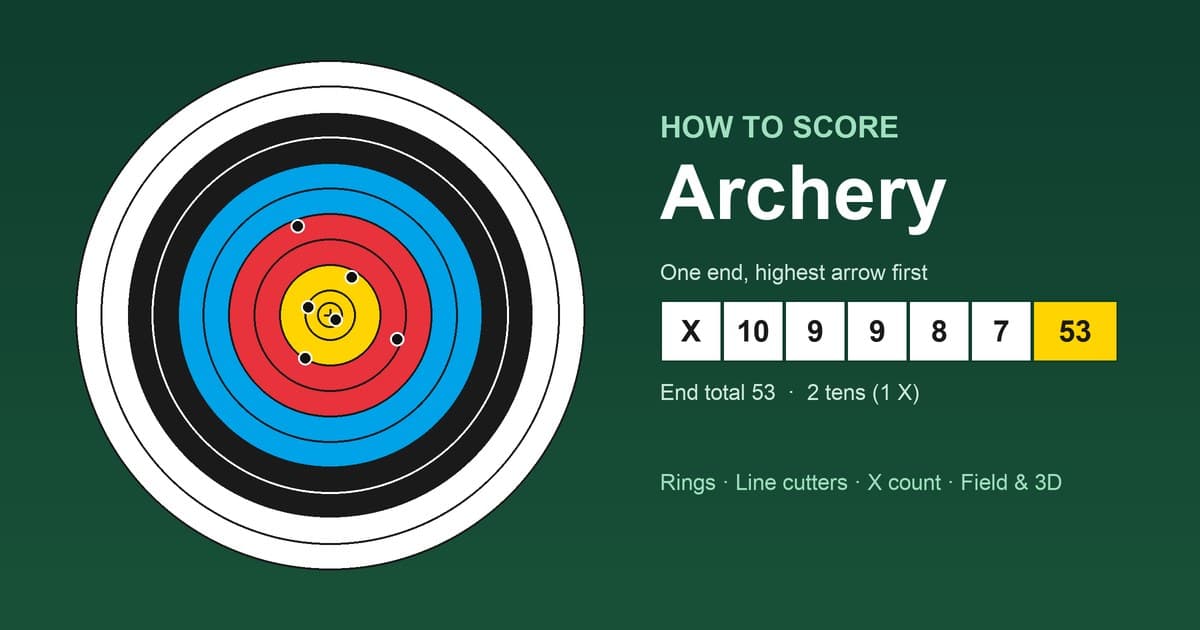
- 2. Call your arrows from highest to lowest. Each archer reads out their own arrows in descending order, for example "X, 10, 9, 9, 8, 7". The scorer writes them in that order (12.1.3).
- 3. The rest of the group checks each call. The other archers on the target confirm the values. For a line cutter, look closely at where the shaft sits, not the hole around it. If the group disagrees, a judge makes the call.
- 4. Add up the end total and the running total. Also count the 10s (including Xs) and the Xs, because they are used to break ties. Indoors, count 10s and 9s instead.
- 5. Fix mistakes before you pull. A mistake on the scorecard can be corrected before the arrows are drawn if all the archers on the target agree, and everyone on the target initials the change (15.1.1). Once the arrows are pulled, an arrow's value can no longer be disputed, because the evidence is gone.
- 6. Pull the arrows and mark the holes. Marking each hole lets a judge identify the right hole if a later arrow bounces off or passes through.
- 7. Sign the scorecard at the end of the round. The scorer and the archer both sign. Signing confirms every arrow value, the total, and the number of 10s and Xs (12.4).
Example: Two Ends on a Scoresheet
Here's how two 6-arrow ends look on a typical outdoor scoresheet. The "10+X" column counts every arrow worth 10, and the "X" column counts only the inner-10 arrows.
| End | Arrows (highest first) | End total | Running | 10+X | X | |||||
|---|---|---|---|---|---|---|---|---|---|---|
| 1 | X | 10 | 9 | 9 | 8 | 7 | 53 | 53 | 2 | 1 |
| 2 | 10 | 9 | 9 | 8 | 8 | M | 44 | 97 | 1 | 0 |
The miss in end 2 is written as "M" and scores 0. After two ends, this archer has 97 points, three 10s and one X. For how scoring fits into a full tournament day, see our guide to your first archery competition.
Target Face Scoring Zones
The World Archery target face has ten equal-width scoring zones in five colors. Counting from the center, gold is 10 and 9, red is 8 and 7, light blue is 6 and 5, black is 4 and 3, and white is 2 and 1. Each dividing line belongs to the higher zone (WA Book 2, 7.2.2). The same face is used for most target archery worldwide, from beginner club rounds to the Olympics.
Standard 10-Zone Target Face
Some rounds use a reduced face that shows only the inner rings. The 80cm 6-ring face used for outdoor compound shows only zones 5 to 10, and indoor triple-spot faces show 6 to 10. An arrow outside the printed rings is a miss.
Does an Arrow on the Line Count? The Line Cutter Rule
Yes. An arrow that touches the line between two zones scores the higher value. World Archery's rule reads: "If the shaft of an arrow touches two colours or any dividing lines between two scoring zones, that arrow will score the higher value of the two zones involved" (WA Book 3, 12.2). NFAA, ASA and IBO use the same principle.
Special Cases: Bouncers, Pass-Throughs and Misses
- • Bouncer: an arrow that hits and falls out scores according to the mark it left on the face (WA Book 3, 12.2.6.1).
- • Pass-through: an arrow that goes through the target scores by the hole the judge identifies. If more than one unmarked hole could be it, the lowest-scoring hole counts (12.2.6.2 and 12.2.6.3).
- • Robin Hood: an arrow embedded in the nock of another arrow scores the same as the arrow it hit (12.2.6).
- • Miss: an arrow outside the outermost scoring zone, or in someone else's target face, is recorded as "M" for 0 points (12.2.6 and 12.2.8).
Why marking holes matters: bouncer and pass-through rulings depend on finding an unmarked hole. If your group marks every hole when pulling arrows, a judge can tell which hole is new.
What Does X Mean in Archery Scoring?
The X is the small inner ring at the center of the 10. On most faces it scores 10, the same as the rest of the 10 ring, and it exists "to help determine ties in ranking" (WA Book 2, 7.2.2.1). It's half the diameter of the 10 ring: 6.1cm on the 122cm face and 4cm on the 80cm face. Results are often written with the count, so "580, 12X" means 580 points with 12 arrows in the X.
How Ties Are Broken (WA)
- • Long distances (outdoor): most Xs, then most 10s
- • Short distances (indoor 18m): most 10s, then most 9s
- • Ties for a cut-off place or a medal go to a shoot-off
- • Source: WA Book 3, 12.5.1 (2026 rules; older rulebooks counted 10s before Xs)
Compound Inner 10 (Indoor)
- • On WA indoor faces, compound archers score 10 only in the inner ring. The rest of the gold scores 9 (WA Book 2, 7.2.2.3).
- • On the 40cm face that makes the compound 10 just 2cm wide, compared with 4cm for recurve.
- • Outdoors at 50m, compound uses the full 10 ring. The inner ring is the X.
Indoor Archery Scoring (18m and 20 Yards)
Indoor target archery is shot at 18 meters (about 20 yards) on 40cm faces, usually in ends of 3 arrows. World Archery's 18m round is 60 arrows for a maximum of 600 (WA Book 2, 4.5.1.1). In the US, the NFAA 300 and Vegas rounds are also popular. Our indoor archery guide covers the ranges and equipment.
Common Indoor Rounds
- • WA 18m Round: 60 arrows on a 40cm single face or a triple-spot face, scored 10 to 1 (the triple spot shows only 6 to 10). Max 600. Compound uses the inner 10.
- • NFAA 300 Round: 60 arrows at 20 yards on a blue face with a white center spot, scored 5-4-3-2-1. Shot in 12 ends of 5 arrows, max 300. Xs are counted as a tiebreaker and are part of the official score (NFAA official rounds).
- • Vegas Round: 30 arrows at 20 yards, 3 per end for 10 ends, on a 40cm face scored 10 to 1 (the 3-spot shows 10 to 6). Max 300, with the X as a tiebreaker (NFAA indoor rounds).
Triple-spot faces: shoot one arrow into each spot. If two arrows land in the same spot, both count as part of the end but only the lower one scores, and the other is recorded as a miss. An arrow outside the blue 6 zone of a spot is also a miss (WA Book 3, 12.2.2.2).
Outdoor Target Archery Scoring (70m and 50m)
The standard outdoor qualification round is 72 arrows. Recurve shoots 70m on a 122cm face, and compound shoots 50m on the 80cm 6-ring face, both for a maximum of 720 (WA Book 2, 4.5.1.1). Ends are usually 6 arrows. The older 1440 round, 144 arrows at four distances, was replaced as the championship qualification round in 2013 (World Archery). It survives as a record and award round.
Common Outdoor Rounds
- • 70m / 50m round: 72 arrows, max 720
- • 1440 round: 36 arrows at each of 90, 70, 50 and 30m (men) or 70, 60, 50 and 30m (women), max 1440
- • Face sizes: 122cm for the longer distances, 80cm for the shorter ones
World Records (72 Arrows)
- • Recurve men: 709, Kim Woojin, 2025 (World Archery, pending ratification)
- • Recurve women: 694, Lim Sihyeon, Paris 2024 (World Archery)
- • Compound men: 719, Jimmy Lutz, 2026 (World Archery, pending ratification)
- • Compound women: 718, Ella Gibson, 2024 (World Archery)
What's a Good Archery Score?
World Archery's Target Awards give an official ladder of score thresholds (WA Book 2, 6.2.3). They're a useful benchmark even if you never claim the badge.
| Round | White | Black | Blue | Red | Gold | Purple |
|---|---|---|---|---|---|---|
| 70m recurve / 50m compound (of 720) | 500 | 550 | 600 | 650 | 675 | 700 |
| 18m indoor (of 600) | 500 | 525 | 550 | 575 | 585 | 595 |
| 18m barebow (of 600) | 480 | 500 | 520 | 540 | 550 | 560 |
Newer archers usually start well below the white award, and that's normal. Compare your scores with your own previous rounds rather than these tables. Our tips for improving archery accuracy cover what moves your average up.
Field Archery Scoring
Field archery is shot around an outdoor course, at marked and unmarked distances over varied terrain. The two main systems score differently.
World Archery Field
- • Yellow center scores 6 (inner) and 5, then 4 to 1 on black or teal rings
- • No X ring. Ties go to the most 6s, then the most 5s
- • 24 targets per round, 3 arrows each (72 arrows), max 432
- • Faces of 80, 60, 40 and 20cm
- • Source: WA Book 4, 22.2 and 22.3
NFAA Field
- • Center spot scores 5, the white rings 4, the outer black 3
- • X in the spot is used as a tiebreaker
- • 14 targets per unit, 4 arrows each, max 280 per unit; a round is two units
- • Source: NFAA official rounds
3D Archery Scoring
3D archery is shot at foam animal targets, and the scoring rings sit over the animal's vital area. Each organization uses its own ring values, so check which rules your shoot follows. A line cutter takes the higher ring in all three systems below. For courses, distance judging and equipment, see our complete 3D archery guide.
ASA
- • Scores 12 / 10 / 8 / 5, miss 0
- • Two 12 rings: the lower one counts unless you call the upper 12 before you shoot. After calling it, the lower 12 only scores 10
- • The 14 ring is only used at special events
- • 1 arrow per target
- • ASA scoring rules
IBO
- • Scores 11 / 10 / 8 / 5, miss 0
- • The 11 is a small ring inside the 10
- • 1 arrow per target
- • Top places are decided by shoot-off; other ties go to the most 11s
- • IBO rules (PDF)
World Archery 3D
- • Scores 11 / 10 / 8 / 5, miss 0
- • 2 arrows per target
- • 24 targets per round
- • WA Book 4
Olympic Archery Scoring: Set Points and Cumulative Matches
Head-to-head matches are scored differently from ranking rounds. Recurve matches use a set system, and compound matches use a cumulative total (WA Book 3, 12.1.4). Compound is joining the Olympic program for the first time at LA 2028 with a mixed team event (World Archery, April 2025). Our Olympic archery guide covers the full event format.
Recurve Set System
- 1. Each set is 3 arrows per archer (max 30).
- 2. The higher set score earns 2 set points. A tied set gives each archer 1.
- 3. The first archer to 6 set points wins, over a maximum of 5 sets.
- 4. At 5-5, a one-arrow shoot-off decides it. The higher score wins, and if the scores are equal, the arrow closest to the center wins.
Team and mixed team matches use the same system but finish at 5 set points (WA Book 3, 12.1.4.2).
Compound Cumulative Scoring
- • 5 ends of 3 arrows (15 arrows), max 150
- • The highest total wins
- • A tie goes to a one-arrow shoot-off
Paper Scorecards vs. Scoring Apps
World Archery requires two scorecards per target, and one of them may be electronic (WA Book 3, 12.1.1). Local events set their own policy, so bring a pencil. For practice, an app does the adding up for you and keeps your score history, which makes it easier to see whether your averages are rising. Our archery app comparison covers the options, and ArcheryBuddy's competition scoring feature shows how we handle tournament rounds.
Frequently Asked Questions
Does an arrow touching the line count as the higher score?▼
Is an X worth more than a 10?▼
What happens if my arrow falls off the bow?▼
What if my arrow passes completely through the target?▼
Can a score be changed after the arrows are pulled?▼
What's the difference between an end and a round?▼
Keep Score Without the Mental Math
ArcheryBuddy scores target rounds from 18m to 90m. Tap X, 10 to 1, or M for each arrow. It totals every end and keeps your session history so you can watch your averages move.