
To overcome target panic, separate aiming from releasing and rebuild a calm, repeatable shot. Common coaching approaches are blank bale shooting at close range, a fixed shot routine or counting, letting down any shot that feels wrong, and a surprise release using back tension, a hinge release or a clicker. Progress usually takes weeks, and a coach helps.
Updated November 2026
You are at full draw, the aim looks good, and then the shot goes before you are ready, or the sight will not settle on the gold. If this sounds familiar, you are not alone. Target panic affects archers at every level, from beginners to international competitors, and many of them have shot their way back out of it.
What is Target Panic?
Target panic is an involuntary disruption of the shot in which an archer releases too early, cannot move the sight onto the centre, or cannot release at all. Archers also call it gold fever or target shyness, and golfers know something similar as the yips. It affects beginners and experienced competitors, and it occurs with recurve, compound, barebow and traditional bows. Most coaches describe it as a conditioned response: after thousands of shots, the brain links the sight picture of the centre with the command to release, and anxiety about the result makes that link fire before the archer is ready. The exact cause is not fully understood, and it does not mean the archer lacks strength or skill. Because it behaves like a learned habit, the usual approach is retraining: changing how and when the release happens so the old trigger loses its hold over the shot.
Target panic is usually treated as a learned, mental pattern rather than a strength problem. That is good news, because learned patterns can be retrained with patient, structured practice.
Types of Target Panic
Target panic shows up in several recognisable patterns, and many archers have more than one. The most common is the premature release, where the shot goes the instant the sight reaches the gold; compound archers often call this punching the trigger. Others freeze off target, with the sight stuck just above, below or beside the centre and unable to settle into it. A third pattern is the drive-by, where the archer swings across the centre and fires on the way through. Less common, but very frustrating, is the inability to release: the archer holds at full draw with a good sight picture and simply cannot let the shot go, often until they have to let down. Naming your pattern helps, because it tells you and your coach which part of the shot to rebuild first, whether that is aiming, holding or releasing.
Premature Release
You release before you are ready, often the moment your sight touches the centre. With a trigger release aid this is known as punching the trigger.
Freezing Off Target
You cannot move your sight onto the gold. It freezes above, below or beside the centre and refuses to move in.
Drive-By Shooting
You swing through the centre and release as you pass, unable to hold steady on the aiming point.
Can't Execute
You hold at full draw with a good sight picture but cannot make yourself release the string.
What Causes Target Panic?
Coaches usually point to a handful of overlapping causes of target panic rather than a single one. The first is outcome anxiety: thinking about hitting the gold or making a score instead of executing the shot. The second is a feedback loop, where one bad shot raises tension, the tension causes more early or forced shots, and confidence drops further. The third is anticipating the shot, meaning the archer consciously decides when to release rather than letting the release happen as part of a steady process. Competition pressure adds to all three, because the stakes feel higher and the body's stress response speeds everything up. Equipment can contribute too: a bow that is too heavy to hold steadily for several seconds makes archers rush, which can start the habit. Most archers find that more than one of these applies, which is why the approaches below combine form, routine and mental work.
Outcome Anxiety
Focusing on results (hitting the gold) instead of the process (executing the shot).
Negative Feedback Loop
A bad shot creates anxiety, which causes more bad shots, which increases anxiety.
Anticipating the Shot
Consciously deciding the moment of release instead of letting it happen as part of the process.
Competition Pressure and Heavy Gear
Higher stakes trigger the stress response, and a bow that is too heavy to hold makes archers rush.
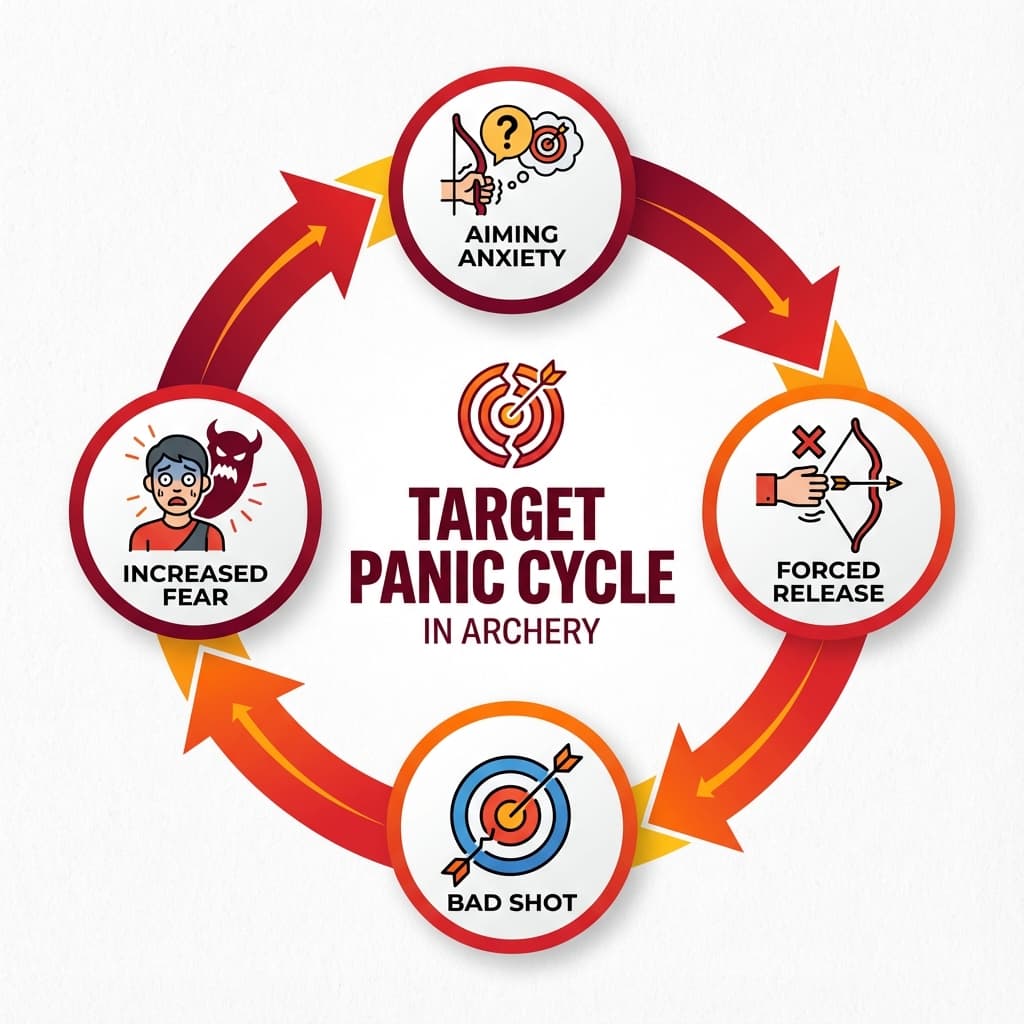
The target panic cycle: breaking this loop is the goal of retraining

Retraining the release is as much about routine and focus as about form
7 Techniques Coaches Use for Target Panic
There is no single proven cure for target panic, but coaches use a consistent set of approaches, and most archers combine several. The common thread is breaking the link between seeing the centre and releasing. Blank bale shooting removes the target face entirely so you can rebuild the release with nothing to aim at. A surprise release, made with back tension and a hinge release on a compound or by expanding through the clicker on a recurve, means the archer no longer decides the exact moment the shot goes. A fixed shot routine or counting gives the conscious mind a job to do at full draw. Letting down when the shot is not right teaches the brain that the sight picture does not automatically mean release. None of these works quickly. Most archers need weeks of patient practice, and a qualified coach can help you choose which to start with and in what order.
1. Blank Bale Shooting
The most widely used starting point. Shoot at a boss with no target face from a few metres away. With nothing to aim at, there is no sight picture to trigger the early release, so you can focus entirely on a smooth shot.
How to do it:
- Remove the target face and use just the boss
- Stand 3 to 5 metres away, close enough that you cannot miss
- Some coaches have you close your eyes at full draw once you feel safe doing so
- Focus only on back tension and a relaxed release
- Shoot a set number of arrows, for example 30 to 50, with full attention
- Many coaches suggest a few weeks of this before a face goes back up
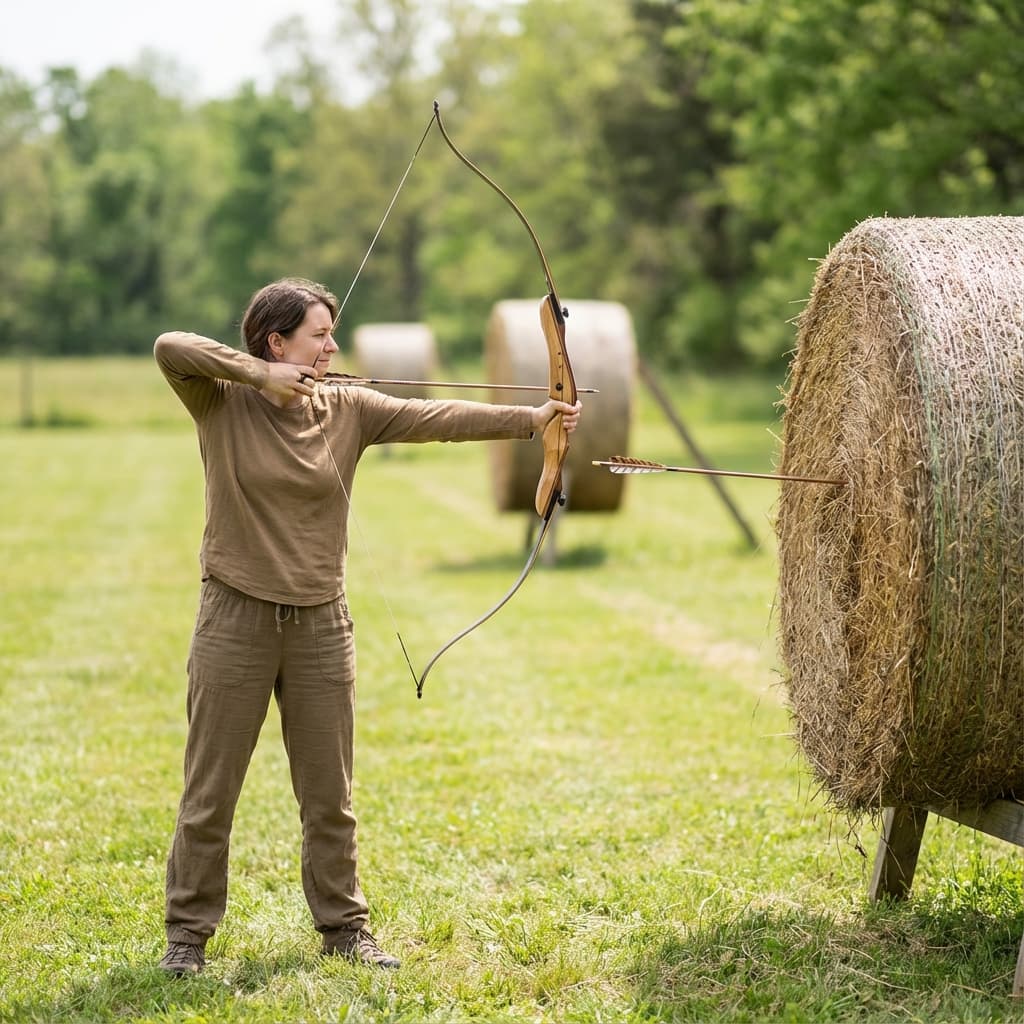
Blank bale shooting removes the visual trigger while you rebuild the release
2. A Surprise Release
Instead of choosing the moment to release, keep expanding with your back until the shot goes. Compound archers often do this with a hinge or back-tension release aid. Recurve archers use the clicker: they keep expanding, the clicker drops, and the fingers relax as a reaction.
The process:
- Reach anchor and settle your aim
- Keep moving the draw-side shoulder blade slowly toward the spine
- Think about pulling through the shot, not at the target
- Let the release or clicker surprise you
- Hold your follow-through until the arrow lands
Learn a new release aid at the blank bale first, ideally with a coach, because a hinge can fire unexpectedly while you get used to it.
3. Process Over Outcome
Shift your focus from "I need to hit the gold" to "I need to run my shot process." The score is a result of good shots, not something you can force.
"I need to hit the X"
"Keep expanding through the shot"
4. Breathing Routine
Use the same breathing pattern on every shot. A common one: breathe in as you raise and draw, let part of the breath out as you settle at anchor, and shoot during the natural pause. A steady rhythm helps keep tension down.
5. A Fixed Shot Routine or Counting
Run the same steps in the same order every time, from stance to follow-through. Some archers count slowly at anchor and keep expanding through the count. This gives the conscious mind something to do besides watching the sight.
6. Let the Sight Float
Accept that your sight will never be perfectly still. Let it float around the centre while you keep executing. Groups are usually centred even when individual shots move a little.
7. Let Down When It Is Not Right
If the sight will not settle, the release starts early, or anything feels wrong, come down under control and start again. Practise letting down on purpose so it becomes a normal part of shooting, not a failure. It teaches you that reaching the centre does not have to mean releasing.
Is It Target Panic or a Form Leak?
Not every stalled score is target panic, and treating a form problem as a mental one can waste weeks. Target panic has a specific signature: you feel the shot go early, or you cannot get the sight into the centre or cannot release, even though you know what you want to do. A form leak is different. The shot feels normal, but something in your body position changes from arrow to arrow, such as a creeping draw hand, a dropping bow arm, a raised bow shoulder or a moving head, and your groups open up or shift. Tracking where arrows land helps tell the two apart. If groups drift in one consistent direction, a form or equipment cause is more likely; if the bad arrows are the ones you felt go early, look at the panic side first. Filming yourself side-on, or asking a coach to watch an end, is the quickest way to check body position.
The short video below walks through how to find the one leak behind a score that has stopped going up.
How Long Does Target Panic Take to Fix?
How long target panic takes to fix varies widely, and there is no reliable figure for it. Many coaches use a staged return like the one below: a few weeks of blank bale shooting only, then a large target face at close range, then gradually longer distances, and finally practice under simulated pressure before competing again. Each stage lasts until the release feels calm and consistent at that level, not for a fixed number of days. Some archers move through in a month or two; others take a season, and panic can return under stress, especially in competition. When it does, the standard advice is to step back a stage rather than push through, because forcing shots tends to reinforce the early release. A short note after each session of how many shots felt clean, and how many you let down, gives a more honest sense of progress than the score alone.
| Phase | Typical range | Focus |
|---|---|---|
| Blank bale only | 2 to 4 weeks | Form and release, no aiming |
| Large face, close range | 1 to 2 weeks | Add a face back, stay close |
| Increase distance | 2 to 4 weeks | Move back gradually, keep letting down bad shots |
| Competition prep | Ongoing | Simulate pressure, keep the routine |
These are common ranges, not guarantees. Move on when the release is calm, not when the calendar says so.
- If panic returns, go back a stage, often to the blank bale
- Avoid pushing through panicked shots; forcing them tends to reinforce the habit
- Compound archers often switch to a hinge or back-tension release aid to get a surprise release
- Mental rehearsal of a calm, complete shot can support practice on the range
- If it persists for months, work with a qualified coach in person
Keep Your Practice Honest
ArcheryBuddy is a free iPhone and Android app with a shot timer for a steady routine and target-face score tracking that plots your groups. Its AI form check scores body position from a short side-on video and gives one fix to work on. It does not diagnose target panic or replace a coach, but it can help you rule out a form leak.
Key Takeaways
- ✓Target panic is usually a learned pattern, not a lack of strength or skill, and it can be retrained
- ✓Blank bale shooting at close range is the most common starting point
- ✓Focus on the process (routine, back tension), not the outcome (hitting the gold)
- ✓A surprise release (clicker, hinge or back tension) and letting down bad shots break the early-release habit
- ✓Expect weeks to months, step back a stage when it returns, and see a coach if it persists
Many archers who now shoot calmly once struggled with exactly this. For related form problems, see our guide to the top 10 archery form mistakes beginners make.