The best archers don't just practice on the range—they train off the range too. Archery exercises and strength training for archers build the specific muscle groups that control your draw, hold, and release. Whether you're struggling with fatigue during long practice sessions or looking to increase your draw weight, this complete archery workout guide has you covered.
⚡ Key Training Principles
- • Back muscles are king—they control your draw and hold
- • Shoulder stability prevents injury and improves consistency
- • Core strength keeps your torso stable through the entire shot cycle
- • Resistance bands are the most archery-specific training tool
💪 Why Strength Matters in Archery
Archery may not look like a physically demanding sport, but holding a bow at full draw requires significant muscular endurance in very specific muscle groups. A typical archery practice involves drawing 30-50 lbs of force, holding it for 5-10 seconds, and repeating that 60-100+ times per session. That's a serious workout for your back, shoulders, and arms.
Benefits of Archery-Specific Strength Training
- • Longer practice sessions — shoot more arrows before fatigue sets in
- • Better form consistency — strong muscles don't compensate or collapse
- • Increased draw weight capacity — safely move up in poundage
- • Injury prevention — balanced muscle development protects joints
- • Steadier hold — less pin float and wobble at full draw
- • Tournament endurance — maintain form through 72+ arrows in competition
Primary Muscles Used in Archery
- • Rhomboids and mid-trapezius — the primary drawing muscles (back tension)
- • Posterior deltoids — rear shoulder, critical for the draw and hold
- • Latissimus dorsi — large back muscles that stabilize the draw
- • Rotator cuff — small stabilizer muscles in the shoulder joint
- • Forearm flexors — control grip and finger hold on the string
- • Core (obliques, erector spinae) — keep your torso stable and aligned
🔙 Back Exercises for Archers
Your back muscles are the engine of your shot. Back tension—the engagement of your rhomboids and mid-trapezius—is what creates a clean, consistent release. These exercises for archers specifically target the muscles that matter most.
🏋️ Bent-Over Rows
The single best exercise for archery-specific back strength. Mimics the drawing motion and builds the rhomboids and lats that power your draw.
🏋️ Reverse Flys
Targets the posterior deltoids and rhomboids—the exact muscles that maintain back tension at full draw. Use light weight and focus on the squeeze.
🏋️ Single-Arm Dumbbell Row
Allows you to train each side independently, correcting strength imbalances between your bow arm and draw arm. Essential for balanced development.
🏋️ Face Pulls
A cable machine exercise that builds rear deltoids and rotator cuff muscles simultaneously. One of the most recommended archery exercises by coaches.
💆 Shoulder Stability Exercises
Shoulder stability is critical for archers because the shoulder joint is inherently unstable—it trades stability for range of motion. The rotator cuff muscles must be strong enough to protect the joint during the repetitive stress of drawing a bow.
⚠️ Shoulder Injury Warning
Rotator cuff injuries are the most common archery injury. If you feel sharp pain in the front or side of your shoulder during drawing, stop immediately. Pushing through shoulder pain leads to tears that require surgery. Prevention through strengthening is far better than treatment.
🔄 External Rotation (Band)
The gold standard for rotator cuff strengthening. Targets the infraspinatus and teres minor—key stabilizers for the bow shoulder.
🔄 Internal Rotation (Band)
Balances the external rotation work. Targets the subscapularis—important for maintaining balanced shoulder strength.
🔄 Scapular Wall Slides
Trains proper scapular movement patterns. Improves the ability to engage shoulder blades correctly during the draw cycle.
🔄 I-Y-T Raises
Comprehensive shoulder and upper back exercise that targets multiple angles. Use very light weight or no weight at all initially.
🧱 Core Exercises for Archers
Your core is the bridge between your upper and lower body. A weak core means your torso sways, twists, or collapses during the shot, especially when fatigued or shooting in wind. These archery exercises build the deep stabilizers that keep you rock-solid.
🧱 Plank (Standard and Side)
Builds isometric core endurance—the exact type of strength needed to hold position through a long end of arrows.
🧱 Dead Bug
Teaches core stability while limbs are moving—directly applicable to drawing a bow while maintaining a stable torso.
🧱 Pallof Press
An anti-rotation exercise that teaches your core to resist twisting forces—essential for maintaining alignment during the draw and release.
🧱 Bird Dog
Trains core stability and back endurance simultaneously. Great for the erector spinae muscles that keep your spine straight during shooting.
🤚 Bow Arm Strength and Endurance
Your bow arm must hold the bow steady against the force of the draw. That requires endurance in the deltoids, triceps, and forearm stabilizers. A shaky bow arm means a wandering sight pin and poor accuracy.
🤚 Front Raises (Hold)
Simulates holding the bow extended. The isometric hold at the top is key—don't just pump reps.
🤚 Wrist Curls and Reverse Wrist Curls
Builds forearm strength for a stable bow grip. Weak forearms lead to bow torque on release.
🤚 Bow Hold Simulation
The most archery-specific bow arm exercise. Simply hold a light weight at bow-arm extension for increasing periods of time.
🪢 Resistance Band Training for Archers
Resistance bands are the single best training tool for archers because they allow you to replicate the exact drawing motion of a bow without the need for a range. You can train at home, in a hotel room, or anywhere you travel.
Pro Tip: Use a band that matches roughly 50-70% of your bow's draw weight. The goal isn't to replicate full draw weight—it's to train the movement pattern and build muscular endurance at a manageable resistance.
🪢 SPT (Specific Physical Training) Draw
The #1 recommended band exercise by Olympic coaches. Simulates the complete shot cycle—draw, hold, expand, and release—without a bow.
🪢 Band Pull-Aparts
Builds the rhomboids and rear deltoids that are essential for back tension. Can be done anywhere with a light band.
🪢 Holding Drill
Builds the endurance needed to hold at full draw longer. Directly improves your ability to aim calmly and execute a clean release.
📅 Weekly Archery Workout Plan
This archery workout plan is designed to complement your shooting schedule, not replace it. Train on non-shooting days or at least 4 hours before a practice session. Each workout takes 30-45 minutes.
3-Day Archery Strength Program
Monday: Back and Shoulders
- • Bent-over rows: 3 x 10-12
- • Reverse flys: 3 x 12-15
- • Face pulls: 3 x 15
- • External rotation (band): 3 x 15 each arm
- • Band pull-aparts: 3 x 15
- • I-Y-T raises: 2 x 8 each position
Wednesday: Core and Bow Arm
- • Plank (standard + both sides): 3 rounds x 30-60 sec
- • Dead bug: 3 x 10 each side
- • Pallof press: 3 x 10 each side
- • Front raises with hold: 3 x 5 each arm (10-15 sec hold)
- • Wrist curls + reverse: 3 x 15 each
- • Bird dog: 3 x 10 each side
Friday: Band Work and Endurance
- • SPT band draws: 30 reps (full shot cycle)
- • Band holding drill: 5 x 20-30 sec holds
- • Single-arm dumbbell row: 3 x 10 each side
- • Scapular wall slides: 3 x 10
- • Bow hold simulation: 3 x 30-60 sec
- • Internal rotation (band): 3 x 15 each arm
Pro Tip: Start with lighter weights and fewer reps than you think you need. Archery muscles are endurance muscles, not power muscles. Higher reps (12-15) with moderate weight are more beneficial than heavy lifting for low reps.
🧘 Stretching Routine for Archers
Flexibility is just as important as strength. Tight muscles restrict your range of motion, limit your ability to achieve proper form, and increase injury risk. Stretch after every workout and shooting session. For a complete pre-shooting warmup routine, check out our archery warmup guide.
Post-Workout Stretching (Hold Each 30 Seconds)
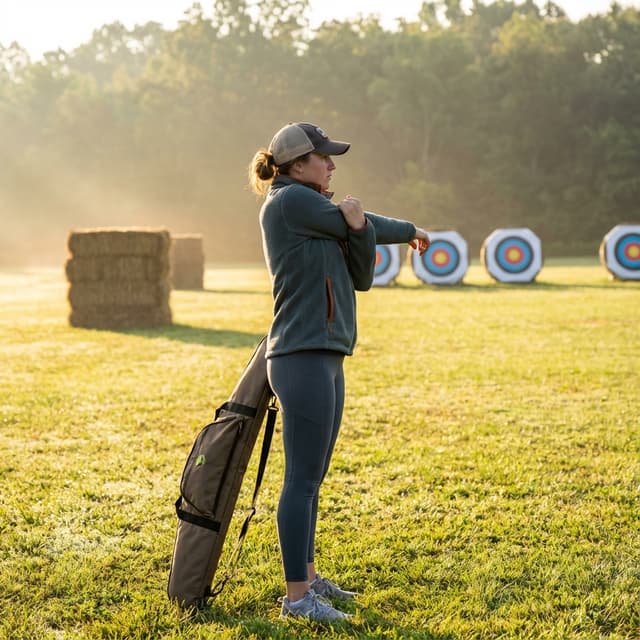
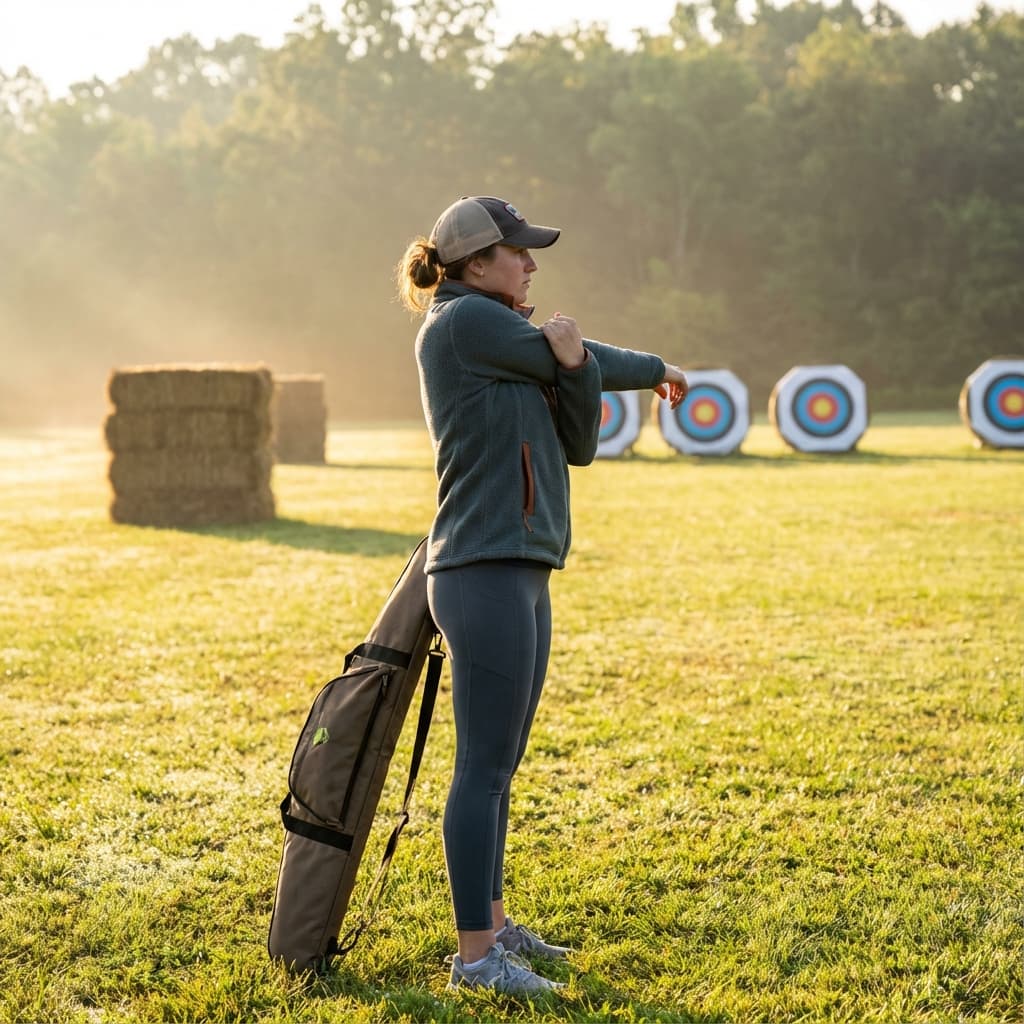
- • Cross-body shoulder stretch — pull one arm across your chest with the other hand
- • Doorframe chest stretch — forearm on doorframe, lean forward to open chest
- • Cat-cow stretch — on all fours, arch and round your spine alternately
- • Thread the needle — from all fours, reach one arm under your body and rotate
- • Wrist flexor/extensor stretch — extend arm, pull fingers back (then forward)
- • Neck side stretches — gently tilt ear toward shoulder, hold each side
- • Lat stretch — grab a doorframe overhead and lean away, feeling the stretch down your side
- • Child's pose — great for lower back and lats, hold 30-60 seconds
✅ Recovery Checklist
- • Stretch after every session—shooting or gym
- • Rest at least 1 day between strength training sessions
- • Ice shoulders for 15 minutes if they feel sore after shooting
- • Sleep 7-9 hours—muscles rebuild during sleep
- • Stay hydrated—dehydrated muscles fatigue faster
- • Listen to your body—sharp pain means stop, not push through
❓ Frequently Asked Questions
How often should I do archery strength training?▼
Will lifting weights make me too bulky for archery?▼
Can I just shoot more arrows instead of doing exercises?▼
What resistance band should I buy for archery training?▼
Track Your Training and Scores
ArcheryBuddy helps you track your practice sessions and scores, so you can see how your strength training translates to better performance on the range.